
For many business owners, one of the most difficult questions during a sale process has nothing to do with valuation, negotiations, or buyer selection. Instead, it’s deciding when to tell employees that the company is being sold.
The challenge is that uncertainty creates anxiety. When employees hear that a sale may be coming, their minds naturally jump to questions such as: Will I still have a job? Will my responsibilities change? What will the new owner be like? Even if the answers ultimately turn out to be positive, months of uncertainty can distract employees and create unnecessary concern.
Because of that, we generally advise owners that the best time to tell most employees about a sale is the morning after the transaction closes.
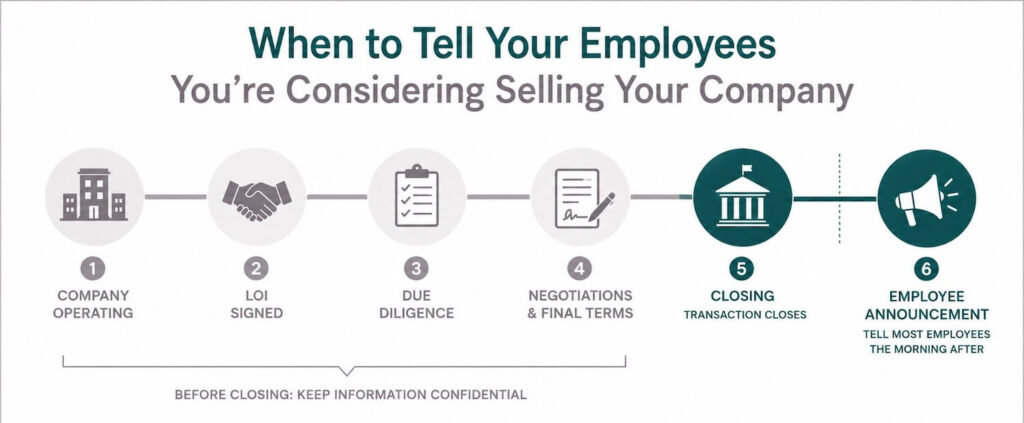
Why Waiting Is Usually the Best Approach
Until a transaction is completed, there are no guarantees. Deals can be delayed, renegotiated, or fall apart entirely. Announcing a potential sale too early can create months of uncertainty for employees without providing any meaningful benefit.
After closing, however, the situation is very different. The owner can communicate with confidence, explain who the buyer is, and share the vision for the company moving forward. In many cases, owners can honestly tell employees that they selected a buyer who will provide stability, resources, and future opportunities for the workforce.
Most business owners also remain involved with the company for some period after closing. Being able to reassure employees that leadership continuity will exist during the transition often helps reduce concerns and maintain morale.
The Risk of Announcing a Sale Too Early
One of the unintended consequences of premature disclosure is employee turnover. An employee who is uncertain about the future may become much more receptive to recruitment calls from competitors. A person who was previously content in their position might think, “I’m not sure what’s going to happen here, so maybe I should explore my options.”
Maintaining stability during a sale process is important not only for business performance but also for preserving value. Buyers want to acquire companies with strong teams and predictable operations. Employee departures can create disruptions that affect both. Managing confidential communications with employees, customers, suppliers, and other stakeholders is a critical part of a successful transaction and an important component of effective Sell-Side Services.
As we discussed in our article, “Private Equity vs. Strategic Buyers: A Comparison for Owners,” different buyers may have different goals for the business, but virtually all acquirers value workforce stability during a transition period.
When Employees Aren’t Surprised by a Sale
When a sale is part of an owner’s retirement plan, employee reactions are often less dramatic than owners expect. If the owner is in their 60s or 70s and has gradually stepped back from day-to-day operations, employees frequently recognize that a transition is likely at some point. While they may feel sentimental about the change, especially if they’ve worked with the owner for many years, they often understand the reasoning behind the decision.
Their primary concern is usually not why the company was sold, but rather what working for the new owner will be like.
When Key Employees Must Be Involved Before Closing
Although most employees should remain unaware until closing, certain key personnel may need to assist with the transaction process.
Financial due diligence often requires support from a controller, CFO, or senior accounting employee who can help provide requested financial information. In these situations, confidentiality becomes critical. The owner should clearly communicate that the potential transaction is highly sensitive and must not be discussed with others.
Buyers also frequently want to meet key managers before closing to confirm they intend to remain with the company after the acquisition. We generally prefer these discussions to occur only after the buyer has completed financial due diligence and confirmed transaction terms. Once key employees are informed, confidentiality is effectively lost among that group, so owners should have a high degree of confidence that the transaction will close before expanding access.
Many owners also consider retention bonuses for essential personnel. These arrangements typically provide a bonus if the employee remains with the company for a specified period, often six to twelve months after closing, which helps encourage continuity during the transition.
Situations Where the Entire Workforce Must Be Told Before Closing
There are exceptions to the general rule. For example, in certain asset sales, employees may technically be terminated by the seller and immediately rehired by the buyer. In those cases, advance communication may be necessary so employees can complete onboarding paperwork, enroll in new benefits programs, or transition to a new payroll provider.
When broad employee communication is unavoidable, owners should ideally wait until the purchase agreement and other transaction documents are substantially finalized. The closer the deal is to completion, the lower the risk of creating unnecessary uncertainty if the transaction does not proceed.
Related Article: M&A Disclosure Schedules: What Are They and How Do They Impact a Seller?
Communicate at the Right Time
Every transaction is different, but in most cases, waiting until after closing to inform employees creates the least disruption and provides the greatest clarity. The goal is to replace uncertainty with facts and to present the transition as an opportunity rather than a source of concern.
An experienced M&A advisor can help owners navigate not only buyer selection and negotiations, but also sensitive issues such as confidentiality, management communication, and employee retention. If you’re considering a sale and would like guidance on timing, process, and transaction planning, Contact Us to discuss your situation confidentially.