
When business owners begin exploring a sale, they are often surprised by the variety of potential buyers in today’s M&A environment. While many owners naturally think of competitors or larger companies in their industry, a significant portion of the buyer universe now consists of private equity (PE) groups, professional investors focused on acquiring and growing businesses.
Understanding the differences between PE buyers and strategic buyers can help sellers better evaluate their options, align with their personal goals, and ultimately make a more informed decision when the time comes to exit.
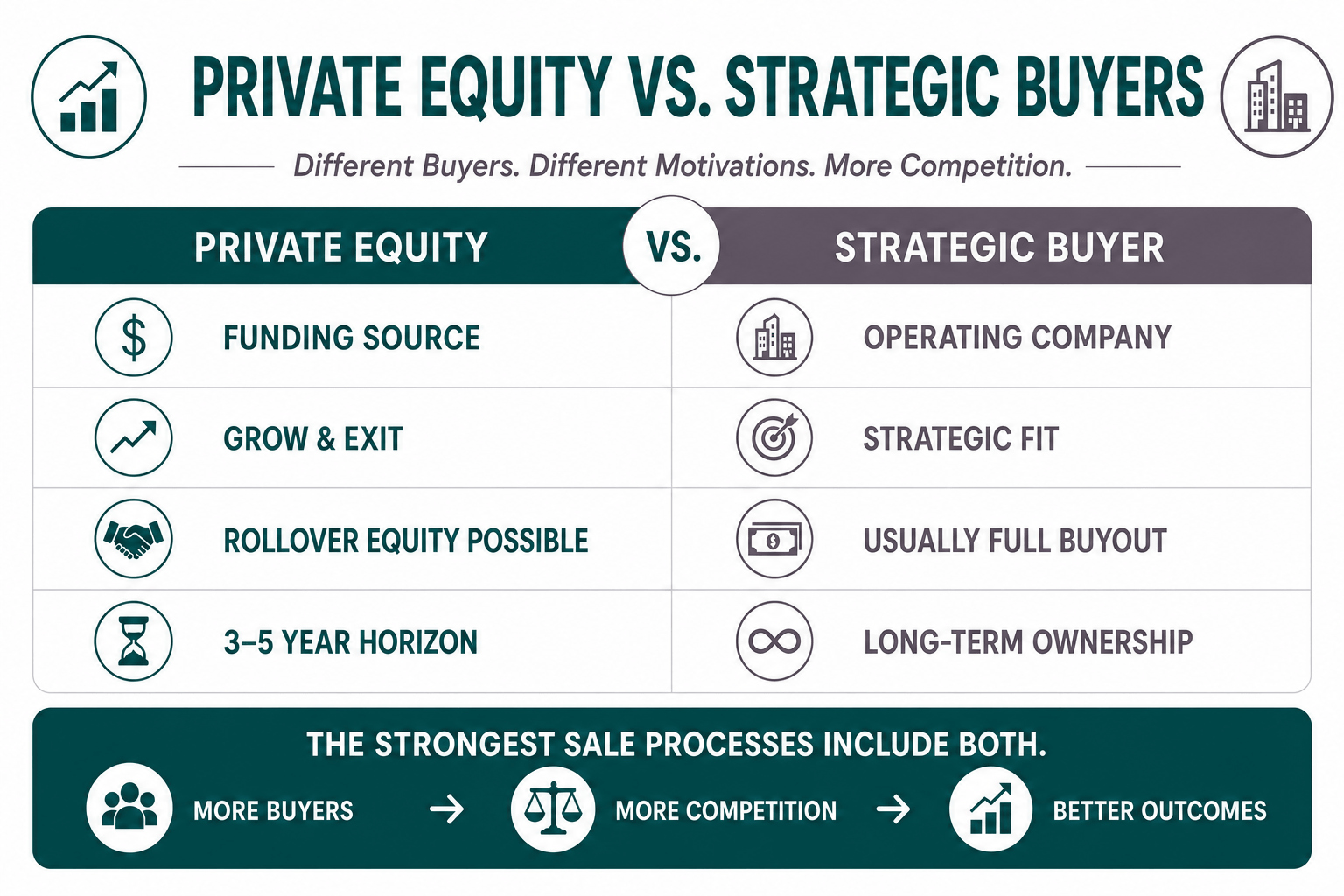
Understanding Private Equity Buyers
Private equity firms typically pursue acquisitions in one of two ways. The first is a platform acquisition, where the PE firm makes its initial investment in a particular industry. In this scenario, the firm backs an existing management team and seeks to grow the company organically while pursuing future acquisitions. The second is an add-on acquisition, where the PE firm already owns a company in the industry and is looking to expand that platform through additional acquisitions.
In our experience, many PE buyers function much like strategic acquirers. They often already have a portfolio company operating in the industry or are partnering with executives who have significant sector experience. While the ownership structure may differ, their growth objectives can be very similar to those of traditional strategic buyers.
PE firms raise capital from a variety of investors, including wealthy individuals, pension funds, union retirement funds, and university endowments. They invest that capital into privately held companies, work to increase value over several years, and ultimately seek to sell those investments at a profit to generate returns for their fund investors.
Understanding Strategic Buyers
Strategic buyers are typically operating companies looking to acquire businesses that strengthen their existing operations. In some cases, the buyer may even be a current PE-backed portfolio company acting as a strategic acquirer. Strategic buyers often pursue acquisitions to:
- Increase market share
- Expand into new geographic markets
- Gain access to new customers, products, or services
- Add experienced management and key employees
- Acquire technology or specialized capabilities
- Improve purchasing power through greater scale
- Reduce competition within their market
Because strategic buyers can often realize operational synergies after closing, they may see value that other buyers cannot. For the right acquisition, this can sometimes translate into highly competitive offers.
As discussed in our previous article, “The Importance of NDAs in M&A Transactions,” maintaining confidentiality throughout the buyer outreach process is critical, particularly when competitors and industry participants are involved in the process.
The Impact of Private Equity Capital on Valuations
Private equity continues to play a major role in today’s M&A market. PE firms collectively have enormous amounts of undeployed capital, commonly referred to as “dry powder,” that is earmarked for acquisitions. Because PE funds operate within defined investment periods, they face ongoing pressure to deploy capital and generate returns for their investors. Combined with the availability of acquisition financing, this substantial pool of capital fuels significant demand for quality businesses across many industries.
As a result, PE buyers frequently help drive valuations in today’s market. In many transactions, what a PE group is willing to pay becomes an important benchmark for competing offers.
This reality is one reason why a comprehensive Sell-Side Process should include both PE groups and strategic acquirers. Limiting outreach to only one category of buyer can reduce competition and potentially leave value on the table.
Beyond Purchase Price: Considering Long-Term Goals
While purchase price is important, it is rarely the only factor owners consider when selling a business. Private equity firms typically have investment horizons of approximately three to five years. Their goal is generally to grow the company and eventually pursue another sale or liquidity event. For owners who are primarily focused on maximizing value, this structure may be attractive, particularly when there is an opportunity to retain equity and participate in a future transaction.
Other owners place greater emphasis on long-term continuity for employees, management teams, customers, or company culture. In those situations, a strategic buyer with a longer-term ownership horizon may feel like a better fit.
Some PE firms have developed reputations for making highly financial decisions focused on short-term performance metrics. While this perception exists, we do not believe it is a reason to exclude PE buyers from consideration. Like any buyer, PE firms vary significantly in their philosophies, operating styles, and approaches to management.
Owners should take the time to understand a buyer’s objectives, expectations, and track record. Speaking with management teams from prior acquisitions can provide valuable insight into what working with a particular buyer will actually be like.
Preparing for Life After Closing
Whether the successful buyer is a private equity group or a strategic acquirer, sellers should generally expect some level of transition involvement following closing.
We often advise clients to plan on remaining involved for two to three years to help ensure a successful handoff to new ownership. The specific employment or consulting requirements can vary considerably from buyer to buyer, but a smooth transition is typically in everyone’s best interest.
Casting a Wide Net Creates More Options
Ultimately, it is impossible to predict whether a PE firm or a strategic buyer will place the highest value on a company or provide the best opportunity for employees. Every buyer views opportunities through a different lens, and the factors driving value can vary dramatically from one prospective acquirer to another.
For that reason, we believe business owners benefit from a broad, competitive marketing process that includes both PE firms whose investment criteria align with the business and strategic buyers. Expanding the buyer universe creates more opportunities, encourages competition, and gives owners a wider range of transaction structures and future partners to evaluate.
If you are considering the sale of your business and would like to discuss how to position your company for both private equity and strategic buyers, Contact Us. Our team can help you develop a thoughtful process designed to maximize options and achieve your objectives.