
This article is part of a series on Shoreline Partners’ core values.
In the lower middle market, signing a letter of intent (LOI) is an important milestone, but it is far from the finish line. More than half of transactions fail to close after an LOI has been signed because a problem emerges that causes one side or the other to walk away. At Shoreline Partners, we refer to these obstacles as “clangers,” and we find that there are typically six to eight of them in every transaction. The reality is not whether clangers will arise, but how effectively they will be addressed when they do.
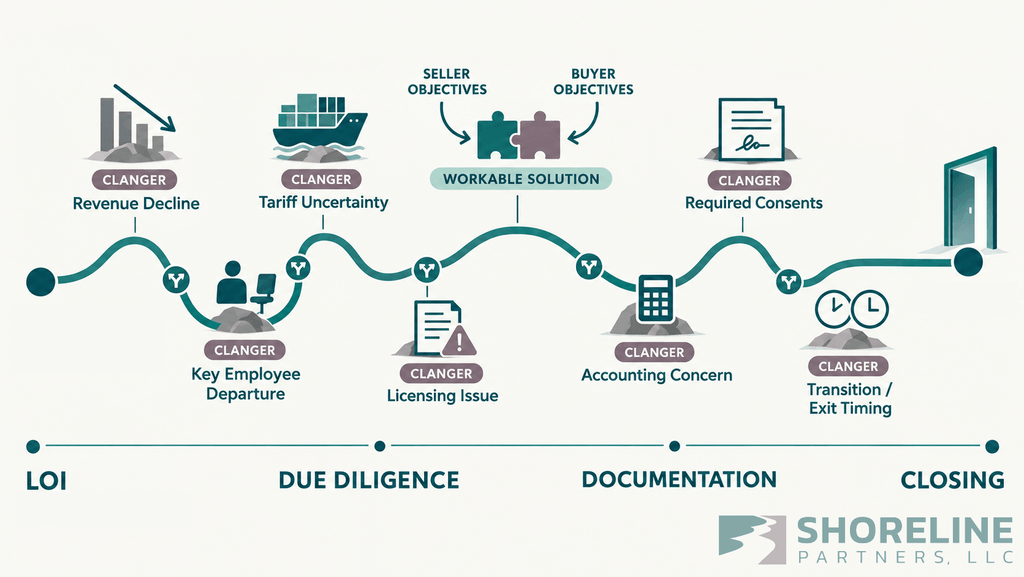
Every Deal Has Clangers
Clangers can surface at any stage of the transaction process, including LOI negotiations, due diligence, and document preparation. Some are relatively minor and can be resolved quickly. Others require substantial creativity, negotiation, and compromise to keep a deal moving forward.
Common examples include:
- Revenue declines during a recent period, even though the seller expects performance to rebound.
- The departure of a key management team member.
- Uncertainty surrounding tariffs and imported materials or products.
- Licensing or regulatory compliance issues.
- Sales tax collection or reporting concerns.
- Accounting deficiencies, including revenue recognition, inventory valuation, or the accuracy of estimates.
- Challenges obtaining required third-party consents before closing.
- Timing differences between when a seller wants to exit and when a buyer wants them to remain involved. (Related article: “How Long Will the Buyer Want the Owner to Stay on After a Transaction?”)
- Disagreements regarding employee retention, relocation of the business, or future employee benefits.
- Structural disagreements, such as a buyer preferring an asset purchase while a seller prefers a stock sale.
- Overreliance on the owner for customer and vendor relationships.
Any one of these issues can derail a transaction. Success depends on identifying a path forward that works for both sides.
The Art of Finding the Middle Ground
One of the most important lessons we have learned from decades of transaction experience is that the best solution is not always either party’s first choice.
In many situations, neither side gets exactly what it wants. Instead, both parties agree to an outcome they can live with because it preserves the larger objective of completing the transaction. The goal is not perfection. The goal is progress.
Creative Problem Solving requires understanding what is truly important to each side and then developing alternatives that address those underlying concerns. A buyer may need protection against a specific risk. A seller may need certainty of proceeds or a defined exit timeline. Once those interests are understood, solutions often become possible. As we recently discussed in “Earnouts: A Useful Tool to Bridge the Value Gap,” deal structure is often where those solutions take shape.”
Why Broad Experience Matters
At Shoreline Partners, we believe our generalist perspective gives us a unique advantage when solving clangers. As discussed in our article “Industry Specialist vs Generalist M&A Advisor: Who’s Best?” experience across multiple industries exposes advisors to a much wider variety of challenges and solutions.
We frequently encounter situations where a solution developed in one industry can be adapted to address a similar challenge in another. An issue that appears unique may actually resemble a problem we have already navigated in a completely different market segment.
This broader perspective allows us to draw from a larger toolbox of ideas and approaches. The result is often a more practical path forward when unexpected challenges arise.
Solving Problems Before They Become Problems
Creative Problem Solving does not begin when a clanger appears. It starts long before the business reaches the market.
As part of our comprehensive Sell-Side Services, we spend significant time upfront gaining a deep understanding of how the business operates and what matters most to the owner. Through our detailed onboarding and discovery process, we actively look for potential clangers before buyers ever begin due diligence.
We have found that many issues can be corrected, mitigated, or properly documented while the company is being marketed. Addressing concerns proactively often prevents them from becoming major obstacles later in the process, when timing pressures are greater and negotiating positions have become more entrenched.
Simply put, the earlier a potential issue is identified, the more options typically exist to resolve it.
Keeping the Deal Aligned
Effective solutions must satisfy more than one audience. A resolution that only benefits the buyer or only benefits the seller rarely succeeds for long.
Our role is to understand our client’s objectives while also recognizing the concerns that motivate the buyer. By balancing both perspectives, we can help craft solutions that preserve momentum and keep negotiations constructive.
This philosophy aligns closely with another of our core principles outlined in “Core Value: Win–Win–Win Outcomes.” Successful transactions require outcomes that work for all parties involved. If one side feels they are absorbing all of the risk or making all of the concessions, the likelihood of closing declines dramatically. Finding that balance is what transforms transaction management from a process into a craft.
Creative Problem Solving Creates Better Outcomes
Every business is different. Every buyer is different. As a result, every transaction presents its own set of challenges.
What distinguishes successful deals is not the absence of clangers, but the ability to work through them thoughtfully and constructively. Experience, preparation, creativity, and an understanding of both sides’ objectives are often the difference between a transaction that falls apart and one that reaches the closing table.
If you believe there are potential clangers that could affect the sale of your business, we invite you to Contact Us. We’d be happy to discuss the challenges you foresee and explore potential solutions that can help keep your transaction on track.