
The market for privately held businesses has become increasingly global. When we bring a company to market, we are rarely limited to domestic buyers alone. Strategic acquirers from Europe, Asia, Canada, and other regions often have strong interest in acquiring U.S. businesses, particularly those looking to expand geographically or establish a presence in the American market. While an international buyer can significantly expand the pool of potential acquirers, the process often introduces additional considerations that sellers may not initially anticipate.
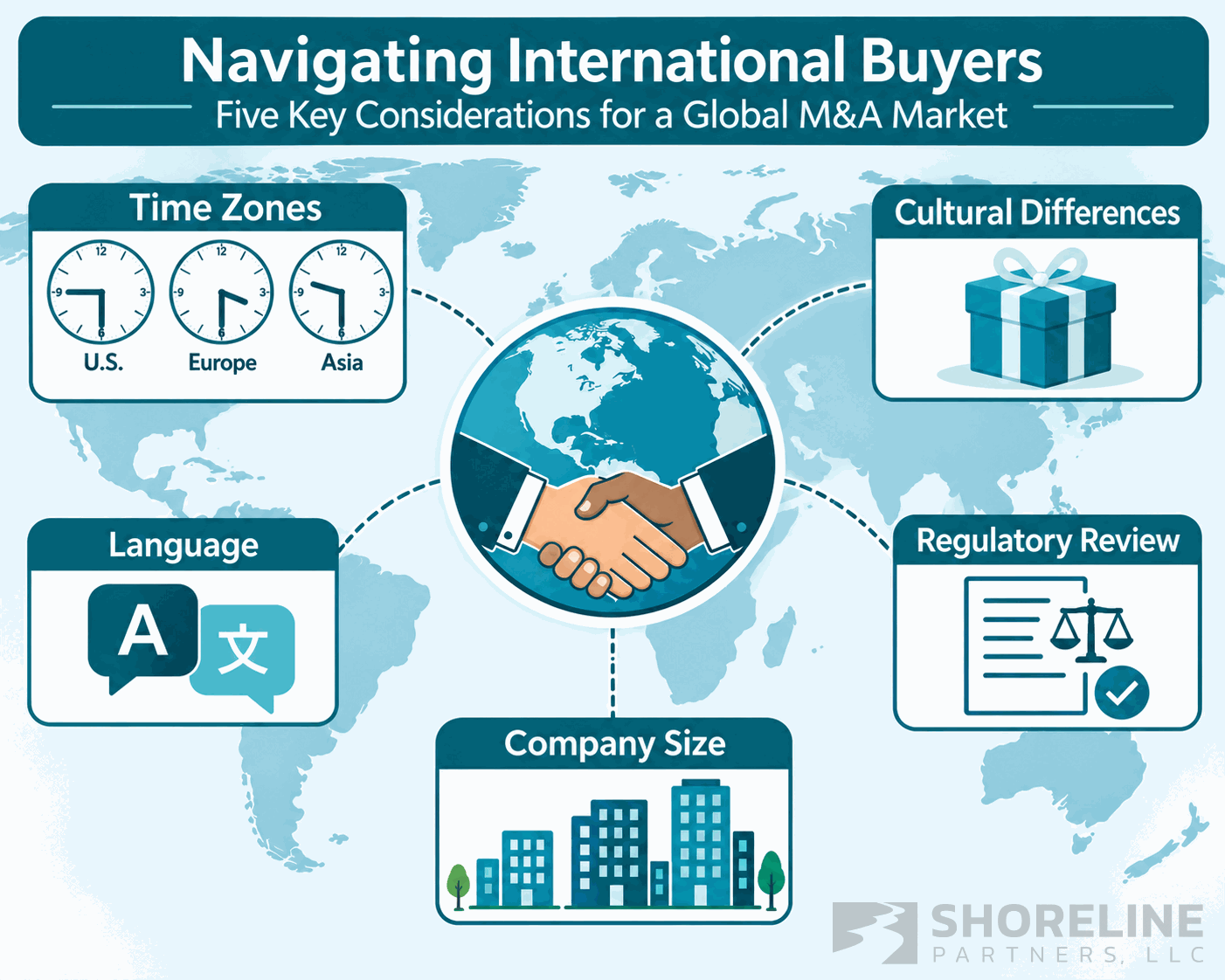
Managing Time Zones and Communication
The most common challenge when working with international buyers is simply coordinating communication across multiple time zones. While technology makes communication easier than ever, scheduling conversations can still require flexibility.
For example, when working with buyers in China, the most practical time for a call is often 5:00 or 6:00 p.m. on the West Coast, which corresponds to 8:00 or 9:00 a.m. the following morning in China. European buyers present the opposite challenge. Since many European countries are eight or nine hours ahead of the West Coast, morning meetings in the U.S. often work best because they fall near the end of the business day overseas.
These scheduling realities may seem minor, but during a transaction there can be dozens of meetings, management presentations, diligence discussions, and negotiations. Maintaining momentum often requires accommodating the schedules of all parties involved.
As we discussed in our article, “Core Value: Straightforward and Unfiltered Communication,” effective communication is critical throughout a transaction. When multiple countries and time zones are involved, careful coordination becomes even more important.
Understanding Cultural Differences
International business relationships often involve cultural expectations that differ from those commonly encountered in the U.S. Understanding these differences can help build trust and strengthen relationships during the acquisition process.
For example, gift giving is a normal and expected part of business culture in some countries. Chinese companies, in particular, often place significant value on exchanging gifts when meeting business partners for the first time.
We recently worked with a Chinese acquirer that traveled to the U.S. to visit one of our clients. The representatives arrived with thoughtful gifts for the seller and key members of management. This exchange of gifts helps establish goodwill and demonstrates respect for the buyer’s business customs.
While every company is unique, taking the time to understand cultural norms can make interactions more productive and create a stronger foundation for negotiations.
Language Is Usually Less of a Barrier Than Expected
Many business owners assume language differences will create significant obstacles when dealing with foreign buyers. In practice, language is rarely a major issue.
English remains the primary language of international business, and most serious acquirers pursuing U.S. acquisitions have team members who are fluent in English. Modern technology has also made communication easier than ever. When researching prospective buyers, we frequently review company websites in their native languages and use translation tools to quickly convert content into English.
While occasional translation support may be required for specific documents or discussions, language differences alone rarely prevent qualified international buyers from participating effectively in a sale process.
Regulatory Considerations
International acquisitions can also involve additional regulatory review. Depending on the industry and the foreign buyer involved, certain transactions may require review by government agencies before they can be completed.
One example is the Committee on Foreign Investment in the United States (CFIUS), which reviews certain foreign investments and acquisitions involving U.S. businesses. While not every transaction is subject to review, it is an important consideration when evaluating potential international buyers, particularly in industries involving sensitive technologies, infrastructure, or national security concerns.
Fortunately, experienced legal counsel can identify potential issues early in the process and help determine whether any additional approvals may be required.
Not Every Business Is a Fit for an International Buyer
Although international buyers can be highly motivated acquirers, not every company is an ideal target for a foreign purchaser.
When a buyer does not already have a U.S. presence, acquiring a business often represents its first step into the American market. Establishing operations in a new country creates additional costs and complexity, which generally means these buyers are looking for a larger platform investment.
In our experience, international buyers entering the U.S. for the first time are typically interested in companies with at least $10 million in revenue, and often substantially more. The infrastructure, management, and operational capabilities of a larger company can justify the expense of establishing a U.S. presence.
For businesses under $20 million in revenue, the most likely acquirers are often domestic buyers or international companies that already have established operations in the U.S. This is one reason why understanding the buyer landscape is so important when developing a marketing strategy. As discussed in “Private Equity vs. Strategic Buyers: A Comparison for Owners”, different buyer groups have different acquisition objectives, resources, and target profiles.
Expanding the Opportunity
International buyers can play an important role in maximizing competition during a sale process. Expanding the buyer universe beyond U.S. borders often creates additional opportunities, introduces new strategic acquirers, and increases the likelihood of finding the right long-term fit for a business.
Of course, working across borders requires thoughtful planning, flexibility, and awareness of cultural and regulatory considerations. When handled properly, however, international buyers can be every bit as serious, capable, and motivated as their domestic counterparts.
If you’re considering a future sale and would like to better understand what the buyer landscape may look like for your company, we invite you to Contact Us to start the conversation.