
One of the most common points of confusion when selling a business is the difference between an asset sale and a stock sale. The distinction matters because it can affect taxes, legal exposure, transaction structure, and ultimately how attractive the deal is to both buyer and seller.
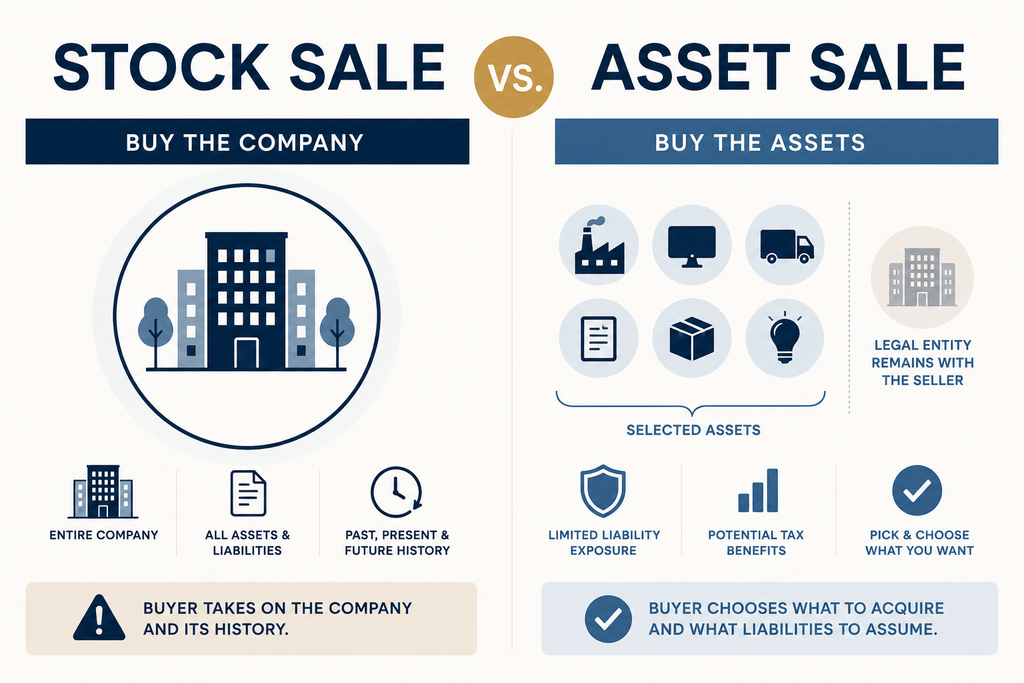
In a stock sale, the buyer purchases all the seller’s ownership interests, whether that’s stock in a corporation or membership interests in an LLC. By acquiring those ownership interests, the buyer takes ownership of the entire business entity, including all the assets owned by the company and used in the business.
In an asset sale, the buyer purchases the individual assets used in the business and assumes certain liabilities, such as routine vendor payables and ongoing performance obligations like facility or office lease payments. The legal entity itself remains with the seller.
Why Buyers Typically Don’t Like to Buy Stock
When a buyer acquires stock, they effectively step into the shoes of the seller. If the company has been operating for five, twenty, or even fifty years, the buyer inherits the entire history of that entity.
That means if something unexpected surfaces after closing, such as a tax issue, an employment claim, a regulatory matter, or another liability tied to the company’s past, the buyer could be exposed. As a result, stock transactions often require more extensive due diligence because buyers need confidence that there isn’t a problem “hiding under a rock” that could come back later.
The more complex the history of the business, the more challenging the stock sale due diligence process can become.
Why Purchasers Often Prefer Asset Sales
Asset sales are generally more appealing to buyers because they can choose which assets they want to acquire and which liabilities they are willing to assume. In most cases, liabilities related to prior business activities remain with the seller’s entity. That can include unpaid employment claims, disputes involving former employees, or other obligations that arose before closing.
Think of the proverbial customer who slips on a banana peel a week before closing. In a stock sale, that claim may follow the company and become the buyer’s problem. In an asset sale, that exposure typically remains with the seller because the buyer purchased assets rather than the entity itself.
Buyers also receive an important tax benefit in many asset transactions. A significant portion of the purchase price for a privately held company is often attributable to goodwill, or the value of the business that exceeds the value of its tangible and identifiable intangible assets. In an asset acquisition, buyers can generally amortize goodwill for tax purposes, allowing them to deduct that value over time. That benefit is not typically available in a stock purchase, making asset transactions even more attractive to many acquirers.
How Entity Type Impacts the Analysis
Whether a business operates as an LLC, S-corporation, or C-corporation can dramatically influence the preferred transaction structure.
LLCs and S-corporations are generally considered pass-through entities, meaning the owners pay tax personally on the business’s income. When assets are sold by a pass-through entity, much of the gain will often pass through to the owners and be taxed at favorable long-term capital gain rates.
A C-corporation is different. The corporation itself pays tax on the gain from the sale of its assets. Then, when the remaining proceeds are distributed to shareholders, those shareholders may be taxed again. This potential “double taxation” is one of the primary reasons sellers of C-corporations often prefer stock sales.
In other words:
- If the business is an LLC or S-corporation, an asset sale is frequently advantageous to the buyer with relatively little downside to the seller.
- If the business is a C-corporation, a stock sale is often more favorable to the seller but less attractive to the buyer.
Because of these differences, transaction structure frequently becomes an important negotiation point during the sale process.
Special Considerations for C-Corporations
If a buyer insists on acquiring assets from a C-corporation, sellers may want to explore whether personal goodwill exists outside the corporation. In certain situations, a portion of the purchase price can be allocated to the owner’s personal goodwill rather than corporate assets.
When structured appropriately, this can move a meaningful portion of the transaction value outside the corporation and potentially allow that amount to receive long-term capital gain treatment. Sellers and their advisors should consider this option when pursuing a transaction.
Sometimes a Stock Sale Makes Business Sense
Despite the advantages of asset acquisitions, there are situations where a stock sale may benefit both parties. For example, some customer contracts require consent before they can be assigned to a new owner. If a major contract remains in place following a change of control but would require consent in an asset transfer, a stock sale may avoid disruption and preserve an important customer relationship. These practical business considerations can be just as important as the tax and legal factors when evaluating transaction structure.
Another consideration is the impact on employees. As we discussed in our previous article, “When Do You Tell Your Employees You’re Considering Selling Your Company?,” transaction planning also affects employees. In a stock sale, nothing changes for employees at the closing; they are still employed by the same entity going forward. However, in an asset sale, their employment is terminated on the closing date, and they are then reemployed by the acquirer.
Ultimately, sellers should focus on the overall economics of the transaction (what they end up with after tax) rather than becoming overly attached to a stock or asset sale structure. Buyers may be willing to pay a higher price for an asset acquisition because of the reduced risk and tax benefits available to them. Those market-based offers often help determine which structure creates the best outcome for everyone involved. You can also learn more about business sale structures and planning in our Transactions resources.
It can be challenging to navigate the differences between an asset sale and a stock sale. Every company has unique circumstances, and the right answer depends on factors such as entity type, tax implications, customer contracts, liability concerns, and buyer preferences. If you’d like to discuss the specific situation of your business, Contact Us today, and be sure to consult with your CPA or tax advisor regarding the tax consequences of any transaction.