
The M&A market remains active in the middle of 2026, but buyers are becoming increasingly selective about the businesses they pursue. While smaller companies often trade at lower multiples than larger organizations, the difference is not simply a matter of size. More often, it reflects the level of risk that buyers perceive when underwriting a transaction. The encouraging news for business owners is that many of those risks can be addressed well before a sale process begins.
Why Larger Companies Command Higher Multiples
When buyers pay premium prices, they are typically rewarding predictability, scalability, and durability. Larger businesses tend to demonstrate these qualities more clearly, but smaller companies can often improve their position by focusing on a few key areas 12 to 24 months before a transaction.
One of the most common concerns is referral concentration. If a disproportionate share of revenue comes from a single referral source or customer relationship, buyers may view the investment as dependent on that relationship rather than the underlying business. Diversifying revenue streams and sources of new business can significantly reduce this risk.
Owner and provider dependence is another frequent issue. Buyers want to acquire a business that can operate successfully without the founder making every major decision. When company operations remain heavily centered on the owner, buyers often respond by structuring portions of the purchase price as earnouts or other contingent payments designed to offset that risk.
Building a Business That Can Scale
For businesses operating across multiple locations, repeatability matters. Buyers place substantial value on organizations that have proven they can successfully open new sites, integrate operations, and replicate performance. Demonstrating a successful multi-site model provides evidence that future growth can be achieved in a consistent and predictable manner.
Strong financial reporting also plays an important role. Accurate revenue recognition, organized contract files, and digitized documentation may not directly increase valuation multiples, but they can help transactions move through diligence more efficiently. Missing documentation or inconsistent records can create delays, increase buyer concerns, and ultimately impact value.
Workforce Stability Continues to Matter
Another area receiving significant attention from buyers is workforce durability. Companies that maintain low employee turnover, effective training programs, and reliable recruiting processes are generally viewed as lower-risk investments.
The concern from a buyer’s perspective is straightforward: if critical employees leave after a change in ownership, or if future growth is constrained by hiring challenges, growth becomes much more difficult, and the projected value of the business may not be realized. Companies with strong training processes, available staffing pipelines, and low turnover rates help minimize those concerns.
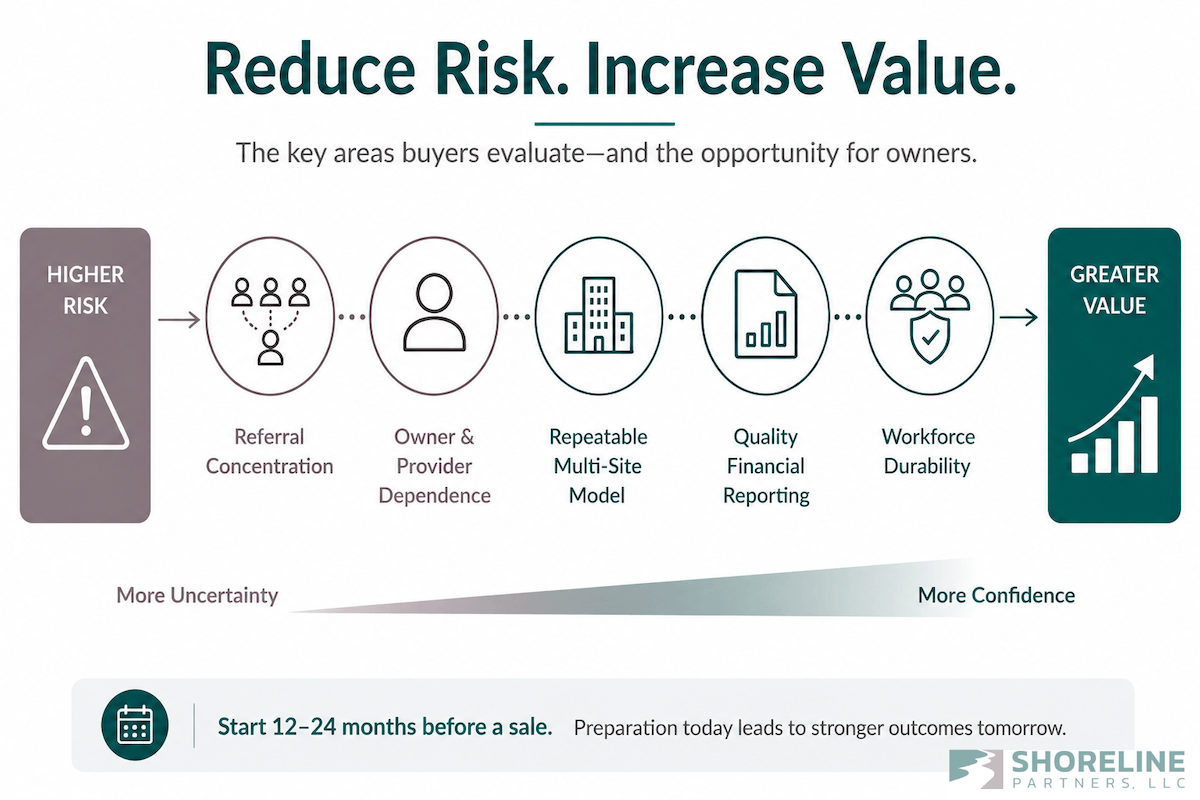
Recognizing and addressing these issues before a company goes to market is often a matter of judgment as much as expertise. As we recently discussed in “The Ongoing Shift in Selecting an M&A Advisor,” information has become increasingly accessible, but the ability to identify what matters most to buyers and proactively address potential concerns remains a critical differentiator. Whether the issue is customer concentration, owner dependence, workforce stability, or financial reporting quality, buyers rarely pay a premium for discovering a well-run business during diligence. They pay more when those risks have already been identified, addressed, and presented as part of a thoughtful sale process.
Midyear Market Statistics
Midyear transaction data indicates that overall deal volume is down slightly compared to 2025, while aggregate deal value has remained relatively consistent. In practical terms, that means fewer transactions are occurring, but larger acquisitions continue to drive a significant portion of market activity.
Another notable trend is the growing use of transaction structures that include earnouts or seller financing. Nearly 54% of middle-market transactions now include one or both of these elements. Buyers are increasingly using structure to address perceived risks and bridge valuation gaps.
For business owners, the takeaway is straightforward: the more risks you can eliminate before going to market, the more likely you are to maximize cash received at closing. Businesses that demonstrate diversified revenue sources, strong management teams, scalable operations, strong financial reporting, and workforce stability are often positioned to achieve more favorable outcomes when a transaction opportunity arises.
If you’re considering a sale in the next few years, Contact Us to discuss what steps can be taken today to strengthen your position and help maximize value when the time is right.