
Many business owners spend years building a profitable company while also managing their tax burden. As a result, the financial statements they use internally or for their tax returns may not fully reflect the earnings power of the business from a buyer’s perspective.
When preparing for a sale, the goal is not simply to show what the company earned historically. The goal is to present what the business would look like under new ownership. That distinction can have a significant impact on how buyers evaluate the opportunity and, ultimately, the value they are willing to place on the company.
Why Adjusted Financials Matter
Some M&A advisors provide prospective buyers with historical financial statements and then separately identify a list of adjustments, commonly referred to as “addbacks.” The expectation is that buyers will mentally incorporate those adjustments when evaluating profitability and determining value.
We believe that approach can create an unnecessary hurdle. When buyers first review financial statements, their attention naturally focuses on the reported historical earnings. If those earnings appear lower than the true earning capacity of the business, the initial impression may be difficult to overcome.
Instead, we prefer to present financial statements that already reflect appropriate and supportable adjustments. This gives buyers a clearer picture of what profitability would have looked like under their ownership and allows them to focus on the real economic performance of the company.
As discussed in our previous article, “What Does ‘EBITDA Multiple’ Mean and How Does It Vary by Industry and Company?”, buyers often value businesses based on EBITDA. If the EBITDA being evaluated does not accurately reflect the ongoing earning power of the company, it can have a direct impact on perceived value.
Common EBITDA Addbacks
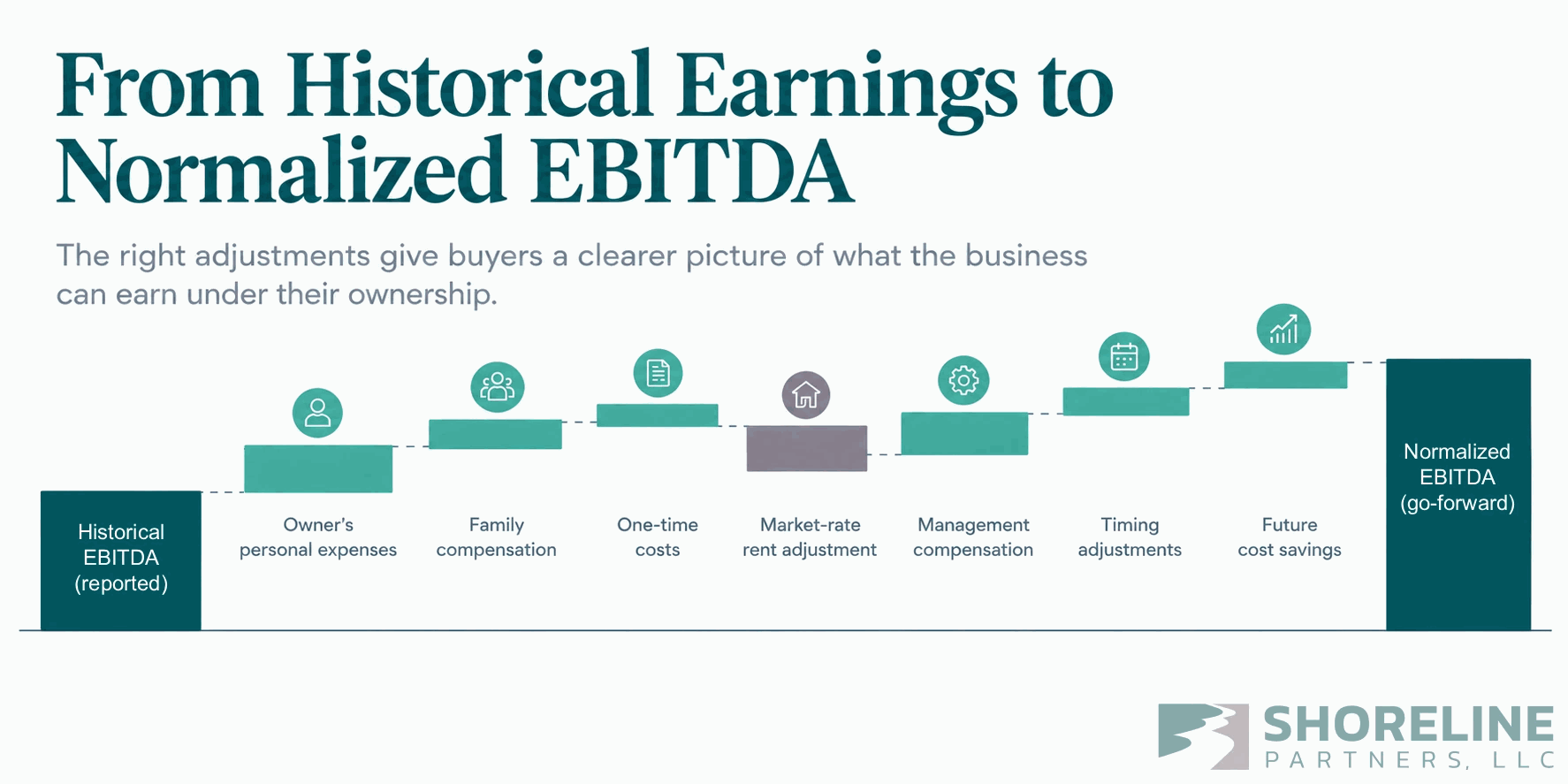
Addbacks are adjustments made to remove expenses or activities that are not expected to continue after a transaction. Common examples include:
- Owner’s personal expenses that have been paid and recorded as expenses through the business
- Compensation paid to family members who are not actively working in the company
- Legal expenses unrelated to normal business operations, such as personal estate planning or one-time litigation matters
- Nonrecurring expenses, including:
- Website redevelopment projects
- One-time software implementation or licensing costs
- Relocation or moving expenses
- Equipment purchases that were expensed immediately but could have been capitalized and depreciated over time
In some situations, adjustments may also be required when a business has closed locations, discontinued product lines, or exited certain services. In those cases, both revenue and expenses associated with those operations may need to be removed to accurately present the continuing business.
Looking Beyond Addbacks
While addbacks receive the most attention, they are only one part of presenting financials properly. Additional adjustments may be necessary to demonstrate what the business will look like on a go-forward basis. These may include:
Normalizing Rent
A company may be leasing property from its owners at a rate that is above or below market. Adjusting rent expense to fair market value helps buyers understand the true economics of the business.
Importantly, not all adjustments increase EBITDA. In some cases, normalizing expenses such as rent may reduce EBITDA. The objective is accuracy, not simply inflating profitability.
Adjusting Management Compensation
Owner compensation may not reflect what a professional manager would earn in the marketplace. Normalizing salaries for owners and key managers can provide a more realistic view of future operating performance.
Correcting Timing Differences
Financial statements do not always align expenses and revenue perfectly with the periods to which they relate. For example, a company may pay and expense a full year’s insurance premium, even though the coverage period spans multiple fiscal years. Adjustments can be made to allocate those costs to the appropriate periods and improve comparability.
Reflecting Future Cost Savings
In certain situations, future improvements are already known and reasonably supportable. For example, if management has successfully negotiated a 3% reduction in the cost of a major raw material, it may be appropriate to reflect those savings through a pro forma adjustment. Because those savings are expected to occur going forward, they may provide a more accurate picture of the company’s earning power than historical results alone.
Credibility Is Critical
The most important rule regarding addbacks and financial adjustments is simple: they must be credible. Every adjustment should be supported by documentation and capable of withstanding buyer scrutiny during due diligence. Unsupported addbacks can damage management’s credibility, create distrust in the financial statements, and ultimately make it more difficult to complete a transaction.
Buyers, lenders, and investors will carefully review the assumptions behind any adjustment. If an adjustment cannot be adequately substantiated, it may be excluded from their analysis.
That is why thorough preparation is so important. Through our sell-side process, we work closely with business owners to identify, calculate, document, and support appropriate adjustments before the company is presented to the market.
Presenting the Financial Story Buyers Need to See
Most owners operate their businesses with two objectives in mind: maximizing cash flow and minimizing taxes. While that strategy can be beneficial during ownership, it often means that reported earnings understate the true profitability of the company.
Our approach is to identify all credible addbacks and normalizing adjustments, post those adjustments directly to the affected income statement line items, and present prospective buyers with income statements that already reflect the company’s normalized operating performance. The result is a clearer financial picture and a more meaningful basis for evaluating the business.
If you’re considering a sale and want to ensure your financials are positioned appropriately for the market, contact us today. We’d be happy to discuss your company, review potential adjustments, and help present your business in a way that accurately reflects its value to prospective acquirers.