
A recent article by The M&A Advisor, “From Expertise to Judgment: Dealmaking’s New Edge,” argues that as information becomes more accessible and AI-powered research tools become increasingly sophisticated, judgment is emerging as the true differentiator in dealmaking. We believe that same shift is changing how business owners should evaluate potential M&A advisors.
For decades, industry expertise was viewed as an important criterion when selecting an investment banker or M&A advisor. While industry knowledge remains valuable, the reality is that market data, transaction research, buyer intelligence, and industry insights are more available than ever before. The most important question is no longer who knows the most. It’s who can apply the right judgment, execute effectively, and successfully navigate a transaction to the finish line.
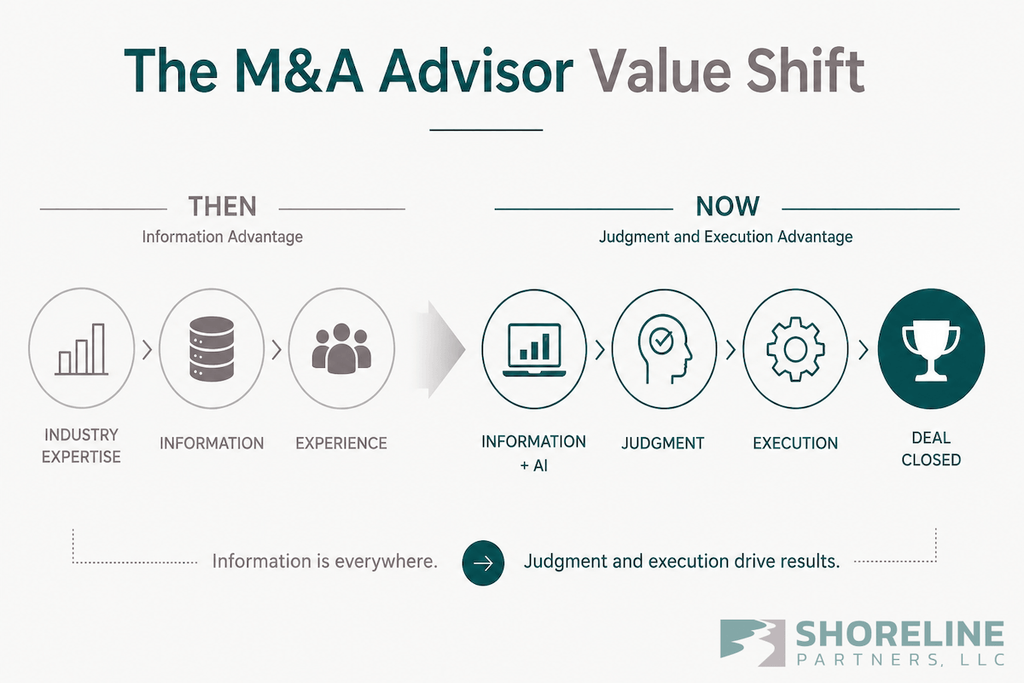
Information Has Become a Commodity
Not long ago, firms differentiated themselves through proprietary research, specialized databases, and years of accumulated industry knowledge. Today, much of that information can be accessed quickly through technology, data platforms, and AI-enabled tools. As The M&A Advisor article notes, the traditional information advantage is shrinking, while the ability to interpret information is becoming increasingly valuable.
For business owners considering a sale, this is an important distinction. Competent advisors can gather market information, identify potential industry buyers, and build financial analyses. The real challenge is determining what matters, what doesn’t, what risks deserve attention, and how to position a company in a way that maximizes buyer interest and transaction outcomes. That is where judgment comes into play.
Judgment Matters More Than Ever
No transaction unfolds exactly as expected. Buyers raise unexpected concerns. Due diligence uncovers issues. Financing markets change. Economic conditions shift. An advisor’s value often becomes most apparent when circumstances deviate from the original plan.
Experience can help identify potential problems, but judgment determines how those problems are addressed. It helps advisors think creatively about potential buyers, evaluate competing offers, manage negotiations (when and how hard to push as well as what terms can likely be negotiated), and keep a transaction moving when obstacles emerge.
This is one reason why selecting an advisor based solely on industry specialization can be risky. Deep industry knowledge may help an advisor understand a business, but knowledge alone does not guarantee successful outcomes. The ability to make sound decisions under uncertainty is often far more important.
Execution Still Wins Deals
The M&A Advisor article emphasizes that organizations are increasingly focused on decision quality and execution capability, not simply expertise. We see the same trend in lower middle market transactions.
A successful sale process requires far more than industry familiarity. It requires thoughtful preparation, disciplined buyer outreach, effective negotiation, proactive diligence management, and the ability to maintain momentum from the initial conversation all the way through closing. In other words, getting a deal done.
Our approach to Sell-Side Services is built around creating competitive tension, generating buyer interest, managing process complexity, and helping owners maximize value. These are execution skills that transcend any single industry.
The Human Element Remains Critical
Ironically, as AI continues to improve, human judgment may become even more valuable. Technology can help analyze data, identify trends, and accelerate research. In fact, we recently explored this topic in “Can AI Increase the EBITDA of a Privately Held Company?”. While AI can certainly create efficiencies and support decision-making, it cannot replace the judgment required to navigate a complex transaction involving multiple stakeholders, competing interests, and significant financial consequences.
Business sales remain deeply human events. Trust, credibility, negotiation, strategic and creative thinking, and leadership continue to play a central role in successful outcomes.
Selecting the Right Advisor
A capable advisor should understand your business model, industry dynamics, and buyer landscape. However, when evaluating potential advisors, business owners should also consider broader questions:
- Does the advisor demonstrate sound judgment?
- Do they have a proven record of completing transactions?
- Can they effectively manage buyers and negotiations?
- Do they have a disciplined process?
- Can they adapt when challenges arise?
As discussed in a previous article, “Industry Specialist vs Generalist M&A Advisor: Who’s Best?”, there is rarely a one-size-fits-all answer. The best advisor is often the one who combines relevant knowledge with exceptional judgment and execution.
As information becomes increasingly available to everyone, those qualities are becoming more important than ever. The future of dealmaking may belong less to those who know the most and more to those who can consistently make the best decisions and successfully execute on them.
If you’re considering the sale of your business and would like to discuss your options, Contact Us to start a confidential conversation.